

Are AI Headshots Safe? Photo Privacy, Data Use and What to Check in 2026
Are AI headshots safe? Learn how AI headshot services handle photo privacy, model training, storage, deletion, security and GDPR before you upload.


Are AI Headshots Safe? Photo Privacy, Data Use and What to Check in 2026
Learn whether AI headshots are safe, what happens to your uploaded photos, and which privacy protections to check before using an AI headshot generator.
Uploading several close-up photos of your face to an AI service is understandably different from uploading an ordinary document.
Your photos are personal. They show what you look like, and an AI headshot service needs to process them closely enough to generate a convincing likeness.
So, are AI headshots safe?
They can be, provided the service is transparent about how your photos are used, protected, stored and deleted.
Before choosing an AI headshot generator, you should be able to answer a few basic questions:
- Are my photos used only to create my headshots?
- Are they used for broader AI-model training?
- How long are they stored?
- Can I delete them myself?
- Who else processes the images?
- What happens if data is processed outside my country?
Those questions tell you much more about AI headshot privacy than a vague claim that a provider is simply “secure.”
What happens to your photos when you create AI headshots?
A professional AI headshot generator needs source photographs so it can create images that resemble you.
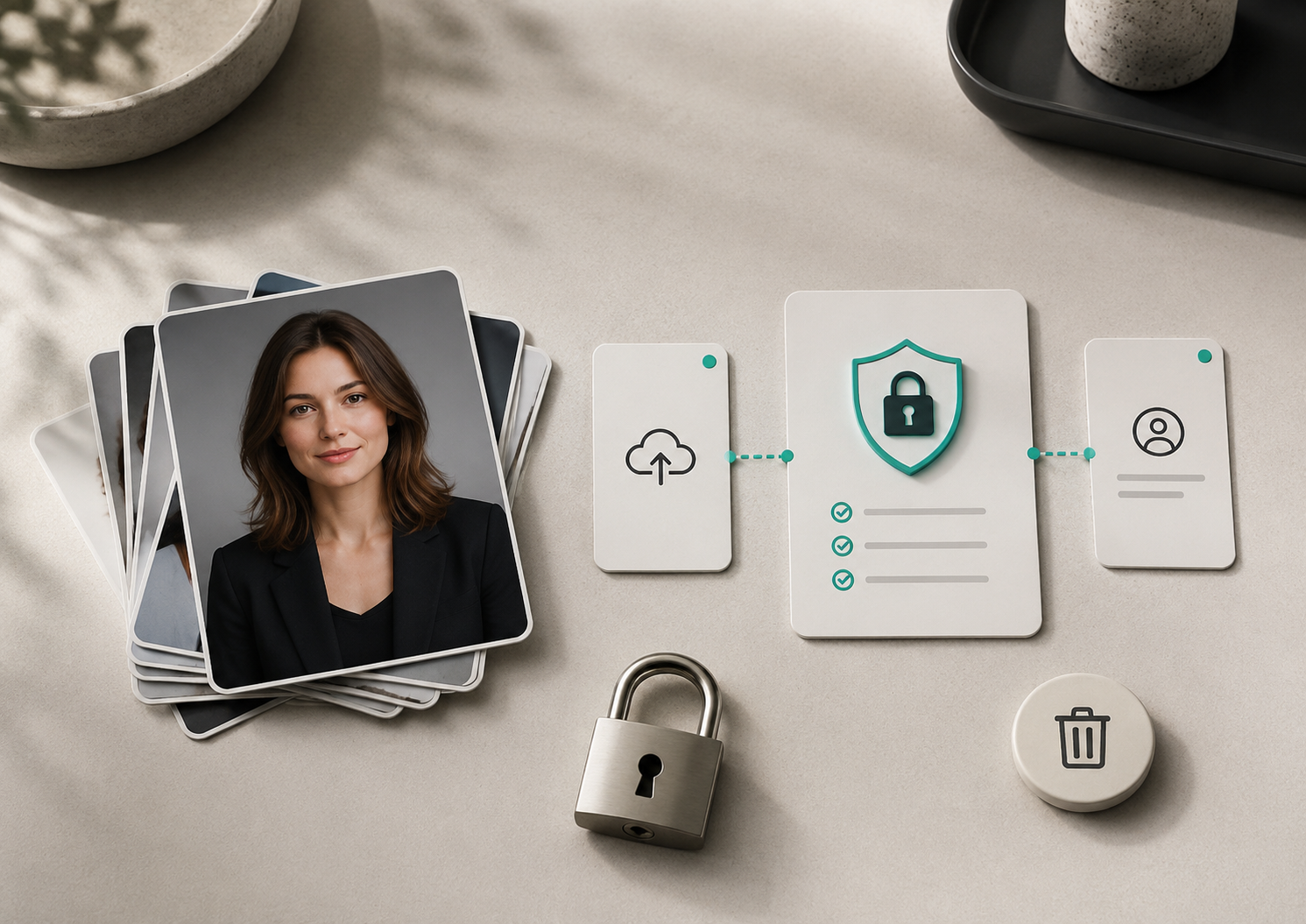
The basic journey is usually:
- You upload recent photos or selfies
- The images are processed to understand your appearance
- The AI generates your professional headshots
- The source and generated images are stored for a defined period
- The images are deleted by you or according to the provider’s retention policy
That process itself is not unusual.
The important privacy question is what happens outside the generation process.
For example:
- Are the images retained indefinitely?
- Are they reused for other purposes?
- Do third-party model providers receive them?
- Can you remove them after generation?
A trustworthy provider should make those answers reasonably easy to find.
Are AI headshot photos used to train AI models?
This is one of the most important things to check.
There is a significant difference between using your photos to generate the headshots you requested and using them later to improve a wider AI model.
HeadshotHQ states across its current product pages that customer photos are not used for foundation-model training.
That is an important privacy distinction.
When you upload your photos to HeadshotHQ, the purpose is to generate your professional headshots rather than contribute your images to the ongoing training of a general-purpose foundation model.
When comparing other providers, look for similarly explicit wording.
If a privacy policy never clearly answers the question, “Are my photos used for AI training?”, that is something worth investigating before uploading.
How long does HeadshotHQ keep your photos?
Data retention matters because even securely stored information does not need to exist forever.
HeadshotHQ’s current privacy policy states that:
- uploaded photos and generated images can be deleted by the user at any time;
- if the user does not delete them manually, they are automatically deleted 90 days after purchase.
That provides a clear end point rather than leaving photos stored indefinitely.
For any AI headshot provider, look for a defined retention period.
“Kept only as long as necessary” may be legally meaningful, but from a customer perspective, a specific deletion policy is much easier to understand.
Can you delete your HeadshotHQ photos yourself?
Yes. HeadshotHQ’s privacy policy currently states that customers can delete their uploaded and generated images at any time.
That matters because privacy is stronger when users have direct control rather than needing to contact customer support and request manual removal.
When reviewing any AI headshot generator privacy policy, check whether it clearly explains:
- deletion of uploaded source images;
- deletion of generated images;
- automatic retention periods;
- what happens to backup copies.
A credible privacy policy should explain what “delete” actually means rather than simply displaying a delete button.
What about facial and biometric data?
Photos of your face deserve additional attention because they can reveal more about you than ordinary files.
HeadshotHQ’s privacy policy specifically acknowledges that facial photographs may qualify as biometric data under GDPR Article 9 and states that where this applies, the images are processed on the basis of explicit consent.
That is a useful disclosure because it does not minimize the sensitivity of facial imagery.
For users, the practical point is simpler:
A provider asking you for multiple facial photographs should treat those images as sensitive personal information and explain clearly why they are needed.
You should not need to understand every provision of GDPR before creating a headshot, but you should expect the provider to have thought seriously about how facial data is handled.
Does HeadshotHQ use third parties?
Like most modern online services, an AI headshot provider may rely on external infrastructure or AI-model providers.
HeadshotHQ’s privacy policy explicitly states that third-party AI inference providers may be used to generate images and that some service providers may process data in other countries.
This is actually the kind of disclosure you want to see.
The existence of third-party infrastructure is not automatically a privacy concern. What matters is whether the provider is transparent about it and has appropriate agreements and safeguards in place.
Be more cautious with services that simply say:
“We never share your data.”
when their product obviously depends on cloud hosting, payment systems or AI infrastructure.
Transparency is more credible than an unrealistic absolute promise.
What security protections should you look for?
Privacy tells you what a company is allowed to do with your photos.
Security concerns how those photos are protected while the company has them.
Useful protections may include:
- Encryption
- Access controls
- Restricted internal access
- Secure cloud infrastructure
- Defined retention periods
- Documented third-party providers
- GDPR-compliant processing where applicable
HeadshotHQ currently uses enterprise-grade encryption and operates according to GDPR requirements.
No online service should claim that storing information on the internet carries zero risk.
What you should look for is evidence that the provider minimizes unnecessary exposure and treats security as part of the product rather than an afterthought.
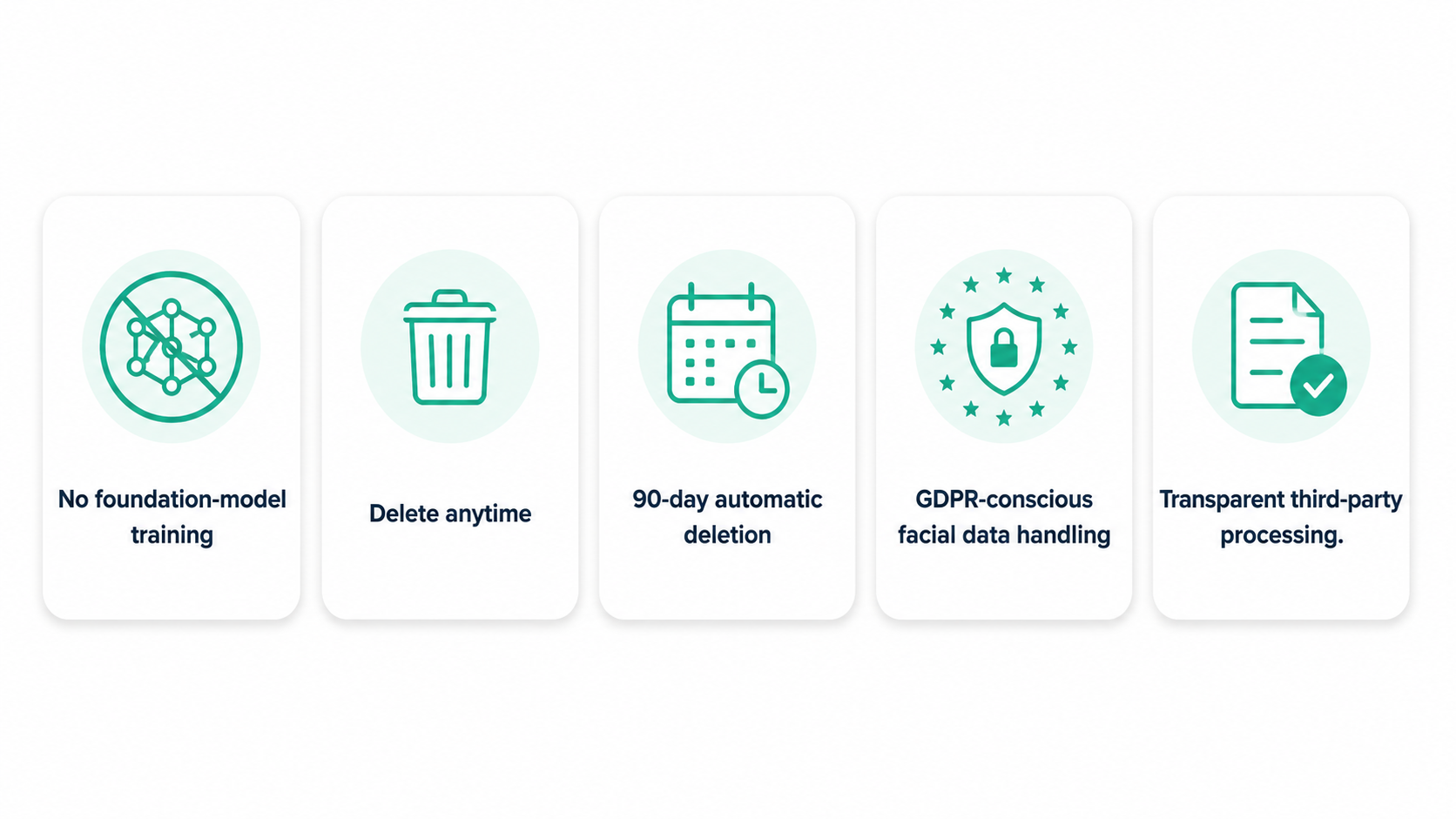
How HeadshotHQ approaches photo privacy
For HeadshotHQ, the privacy proposition can be summarized fairly simply:
Your photos are used for your headshots
Customer images are not used for foundation-model training.
You control deletion
Uploaded photos and generated images can be deleted at any time.
Images are not kept indefinitely
If you do not delete them yourself, HeadshotHQ’s current policy says they are automatically deleted 90 days after purchase.
Facial-data processing is addressed explicitly
The privacy policy acknowledges that facial imagery may qualify as biometric data and describes explicit consent as the applicable basis where Article 9 GDPR applies.
Third-party AI infrastructure is disclosed
HeadshotHQ acknowledges the use of AI inference providers and possible international processing rather than pretending all processing happens inside one isolated system.
That combination is important because privacy is not just one promise. It is a series of controls covering the entire photo lifecycle.
AI headshot privacy checklist: what to check before uploading
Before using any AI headshot generator, look for clear answers to these six questions:
- Are my photos used for AI training?
Look for a direct yes-or-no answer. - How long are my images stored?
Defined retention periods are easier to assess than indefinite storage. - Can I delete my photos myself?
Direct user control is preferable. - How is facial data handled?
The provider should recognize that facial photographs are sensitive personal information. - Are third-party providers involved?
Transparency around cloud and AI infrastructure matters.
• 6. How is my data protected?
Look for meaningful security information rather than vague assurances.
Privacy red flags to avoid
Be cautious if an AI headshot service:
- Has no accessible privacy policy
- Does not explain whether images are used for AI training
- Gives no indication how long photos are retained
- Offers no meaningful deletion mechanism
- Says nothing about third-party processing
- Makes unrealistic claims such as “100% risk-free”
- Makes it difficult to identify who operates the service
A long privacy policy is not necessarily a good privacy policy.
The better test is whether, after reading it, you can actually explain what will happen to your photographs.
Your headshot should be professional. Your privacy should be too.
Using an AI headshot generator means trusting a company with photographs of your face.
That makes privacy a reasonable part of the buying decision.
Before uploading, check:
- whether your photos contribute to AI training;
- how long they are kept;
- whether you can delete them;
- how they are protected;
- and which outside providers may process them.
HeadshotHQ’s current privacy policy provides specific answers to each of those areas, including no foundation-model training, user-controlled deletion and automatic deletion after 90 days.
That is ultimately what you should expect from any AI headshot service:
professional results without losing control of your photos.
Share this article