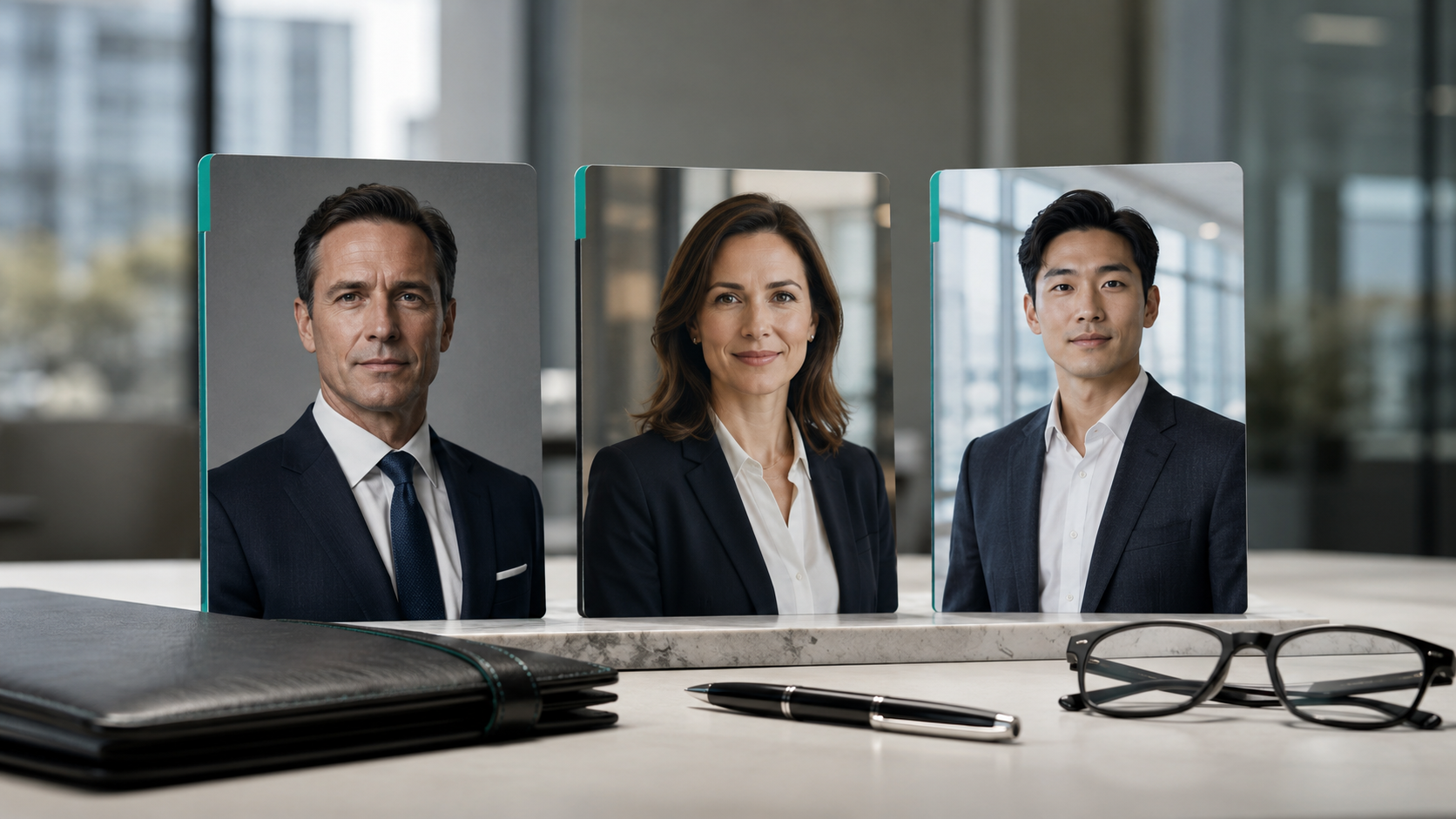


What Makes a Strong Lawyer Headshot?
Learn what makes strong lawyer headshots, including the best expressions, clothing, backgrounds, framing and styling for law firms and LinkedIn.


What Makes a Strong Lawyer Headshot?
Learn what makes a strong lawyer headshot, including the best expressions, clothing, backgrounds, framing and styling choices for appearing credible, approachable and professional across law-firm websites and LinkedIn.
For lawyers, a headshot does more than fill a profile box.
It may appear on a law-firm website, LinkedIn profile, attorney directory, conference page or client-facing biography. In many cases, it is one of the first visual impressions a prospective client, colleague or recruiter gets.
That makes lawyer headshots slightly different from ordinary professional portraits.
The strongest ones balance two qualities that can easily work against each other:
Authority and approachability.
You want to look credible enough that someone would trust you with an important legal matter, but not so severe that the image feels cold or inaccessible.
That balance comes down to expression, clothing, background, framing and, above all, whether the portrait still looks convincingly like you.
The qualities that define a string lawyer headshot
A strong professional lawyer headshot usually has six characteristics:
- A recognizable and current likeness
- A confident but natural expression
- Appropriate legal-professional clothing
- Clean, restrained framing
- A background that supports rather than distracts
- Styling that fits the lawyer's actual role and clientele
The goal is not necessarily to look as formal as possible.
A senior corporate partner, criminal-defense attorney, family lawyer and in-house counsel may all benefit from slightly different visual styles.
The common thread is professional credibility without unnecessary stiffness.
1. Start with credibility, but avoid looking intimidating
Legal work carries an expectation of competence and seriousness.
That does not mean your headshot needs to look stern.
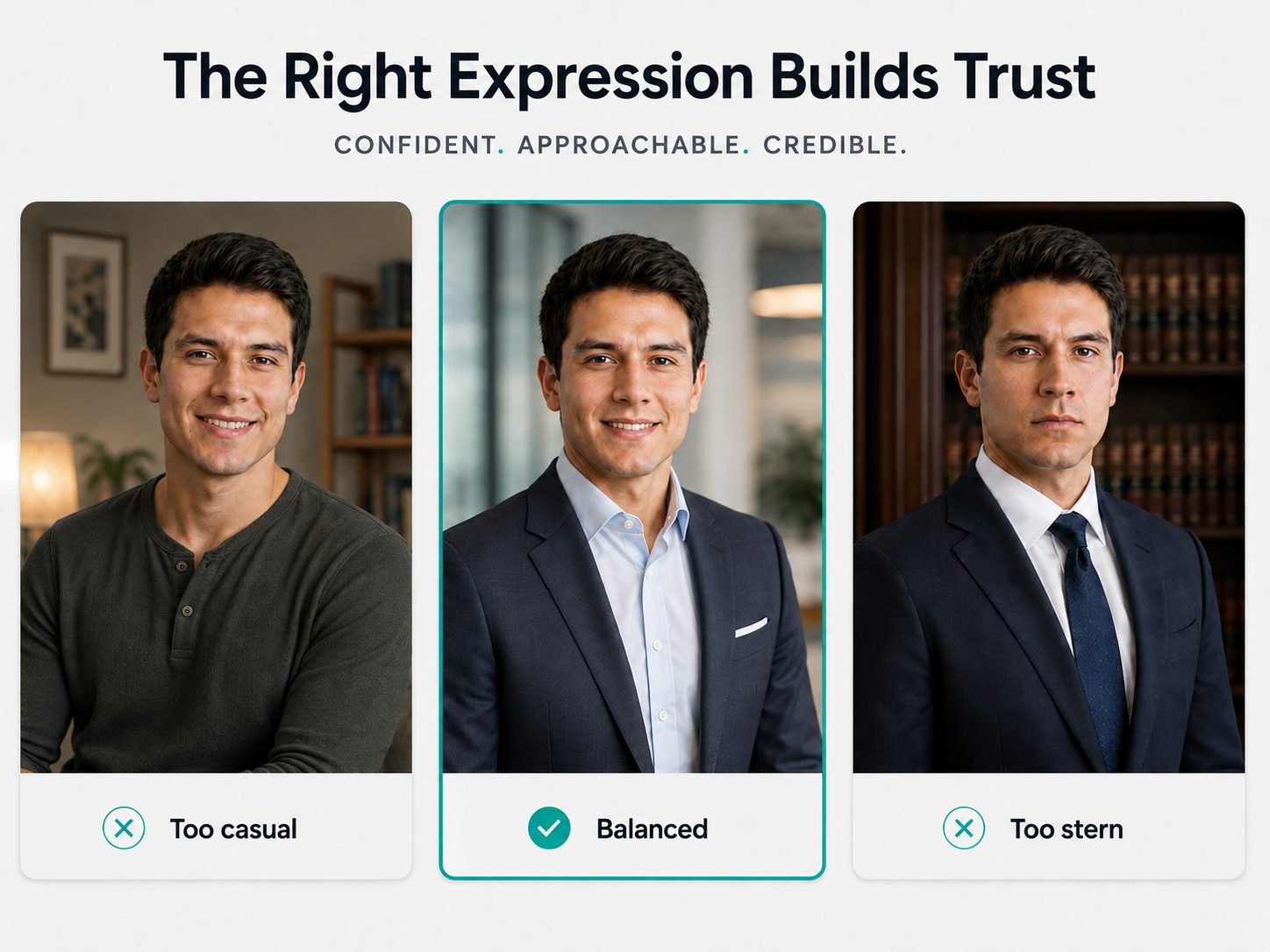
In fact, an overly severe expression can work against you, especially in client-facing areas such as family law, immigration, employment law or private-client work.
A useful expression usually sits somewhere between:
- a broad social smile; and
- a completely expressionless corporate portrait.
A subtle smile or relaxed, confident expression often works especially well.
For lawyers in highly formal environments, such as senior corporate practice or litigation, a more composed expression may be appropriate. For lawyers whose work depends heavily on trust and personal interaction, a warmer expression can make the profile feel more accessible.
The best test is simple:
Would this expression feel natural if a client met me in person tomorrow?
If not, choose another image.
2. Choose clothing that fits your practice area
There is no universal lawyer-headshot uniform.
A traditional suit remains a strong option, but the level of formality should reflect the professional environment you actually work in.
Corporate law and senior partners
A structured suit, blazer or similarly formal clothing usually fits well.
Dark navy, charcoal and muted neutral tones tend to feel authoritative without appearing theatrical.
Litigation and traditional private practice
Formal business clothing often works particularly well because clients may expect a more conventional legal image.
In-house counsel and technology-focused legal roles
A blazer with an open-collar shirt or other polished business-casual styling may feel more natural than a highly formal suit.
Boutique and client-facing practices
A softer professional style can work well where approachability is important.
The objective is not to wear the most expensive or formal outfit.
It is to look consistent with how someone would reasonably expect you to appear in a professional meeting.
If you are using HeadshotHQ, your source selfies do not need to show you already wearing legal-professional clothing. HeadshotHQ currently lets users choose outfits and backgrounds before uploading suitable existing photos or selfies.
3. Use a background that reinforces professionalism
The best background for a lawyer headshot is usually understated.
Good options include:
- Neutral studio backgrounds
- Soft grey, beige or charcoal
- Blurred office environments
- Refined professional interiors
- Clean architectural settings where available
The background should never become more memorable than the person.
For a law-firm website, neutral backgrounds can also make it easier to keep multiple attorney profiles visually consistent.
A blurred office or professional interior can add slightly more context, while a simple studio background tends to be more timeless.
Avoid making the background excessively dramatic just because the image looks impressive at full size. Lawyer headshots often appear relatively small on websites and directories, where simplicity tends to work better.
4. Get the framing right
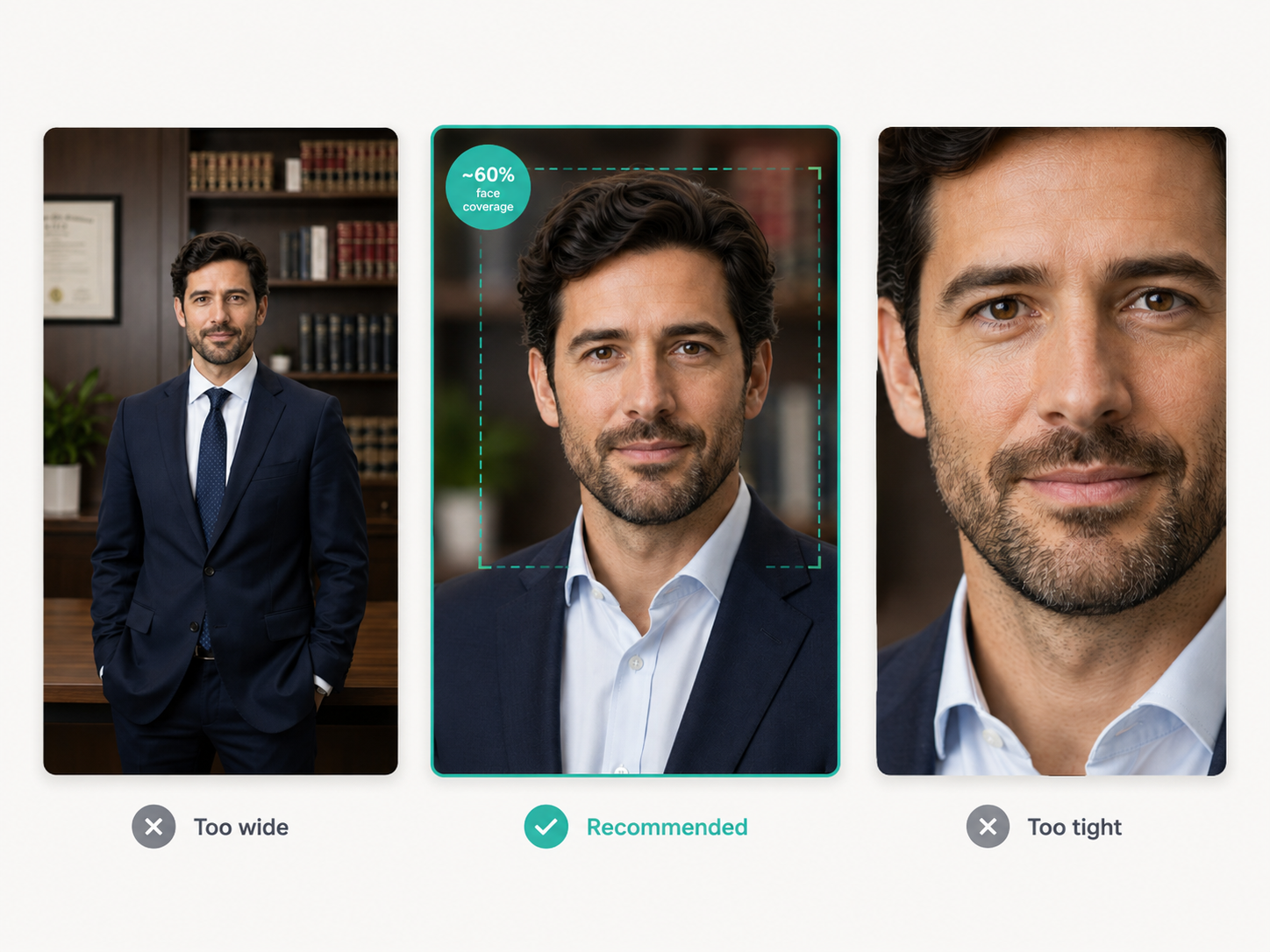
A strong lawyer profile photo should generally be framed from around the shoulders or upper chest to just above the head.
This works especially well for LinkedIn.
LinkedIn's current profile-photo guidance recommends that your face occupy around 60% of the frame and suggests cropping from roughly the shoulders to just above the head.
That is a useful rule beyond LinkedIn too.
A portrait that includes too much of the body can lose impact when displayed as a small attorney-profile image.
Likewise, an extreme close-up can feel overly intense.
Aim for enough space to show some clothing and shoulders while keeping the face clearly dominant.
5. Make sure the image looks like you
This matters for any professional headshot, but especially when using AI-generated portraits.
A strong image can improve:
- Lighting
- Clothing
- Background
- Composition
- General presentation
It should not make you look like another person.
LinkedIn explicitly requires a profile image to reflect the member's likeness, and its guidance emphasizes using a recent, recognizable photo.
For lawyers, recognizability also supports credibility.
If a client has seen your profile before arriving at your office or joining a video call, the experience should feel consistent.
Be cautious with a headshot that:
- Changes your facial proportions
- Makes you look substantially younger
- Removes distinctive features
- Appears excessively retouched
- Creates skin or hair that looks artificial
A polished image is useful.
An unrealistic one is not.
6. Match the headshot to where it will be used
The same lawyer may need a headshot for several contexts.
Law-firm website
Consistency often matters.
If several lawyers appear side by side, similar framing, lighting and background styles make the firm look more cohesive.
Recognizability, close framing and a natural expression are especially important.
LinkedIn currently recommends a recent photo, a simple background and close facial framing.
Attorney directories
A clean, conservative portrait is usually safest because directory layouts vary and photographs may appear very small.
Speaker or conference profile
You may have a little more room for personality, particularly if your practice involves public speaking, media appearances or thought leadership.
Personal website
This can support a slightly more distinctive style, provided the image still feels appropriate for legal practice.
You do not necessarily need one photograph for every platform.
Having several professional options can make it easier to choose an image that fits each context.
Modern lawyer headshots do not need to look old-fashioned
Traditional lawyer photography often defaults to the same formula:
Dark suit. Grey background. Serious expression.
That can still work.
But it is not the only credible option.
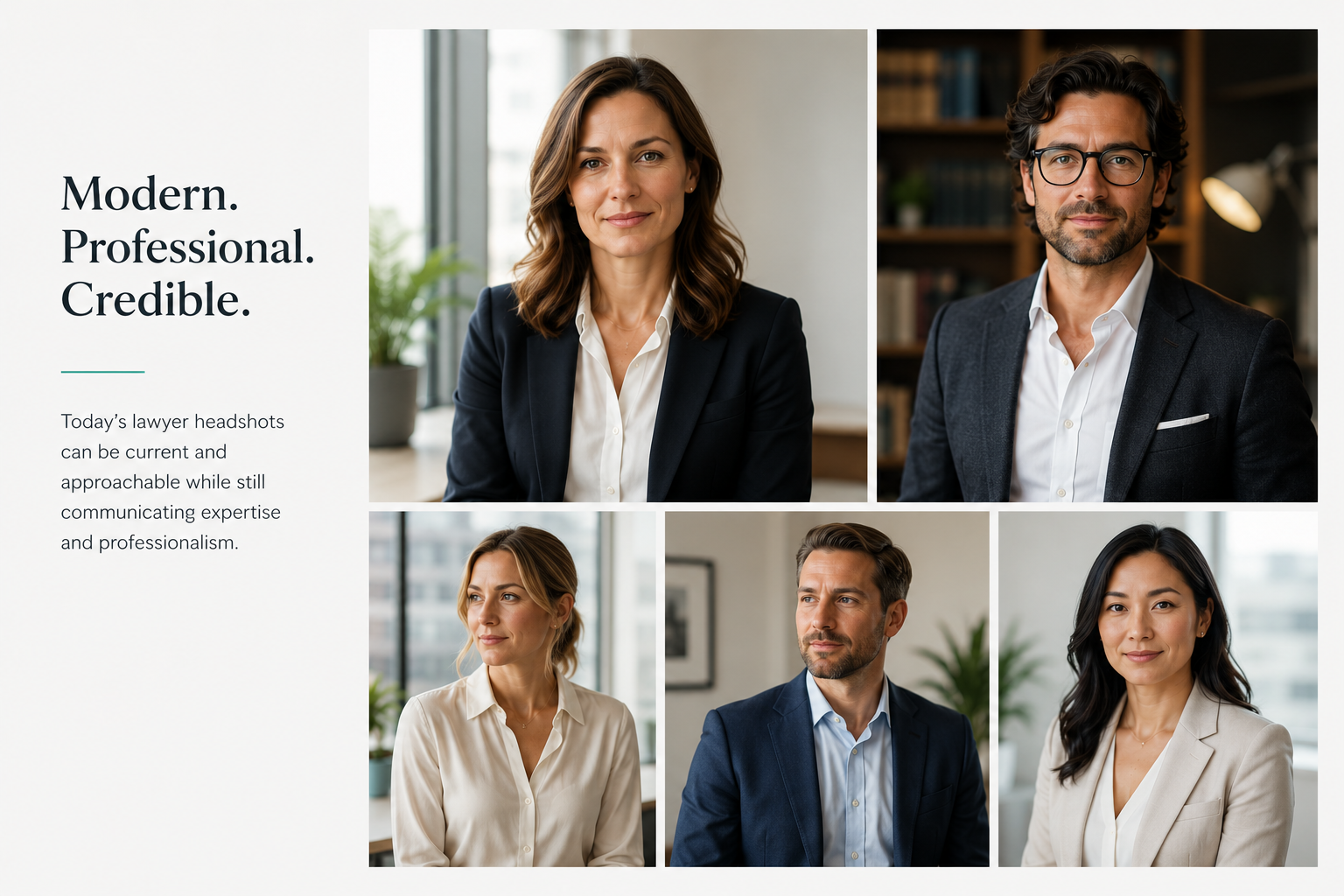
A modern lawyer headshot might use:
- A brighter professional setting
- An open-collar shirt
- A softer background
- A warmer expression
- Contemporary tailoring
- Slightly less rigid posing
The key is maintaining professional intent.
Modern does not mean casual.
It simply means the image feels current rather than overly staged.
Should lawyers smile in headshots?
Usually, some degree of warmth helps.
A large smile is not required.
For many lawyers, a subtle smile creates the best balance between authority and approachability.
Think about the impression created by three possibilities:
Very serious: authoritative, but potentially intimidating.
Subtle smile: confident, calm and professional.
Broad smile: warm and approachable, but possibly too informal for certain practices.
None is universally correct.
The right expression depends on your role, audience and personality.
Are AI headshots a good option for lawyers?
They can be particularly practical for lawyers who need professional images without arranging a studio session.
HeadshotHQ currently allows users to choose available outfits and backgrounds, upload suitable existing photos or selfies, and receive a range of generated professional headshots.
That can be useful when:
- Your current firm photo is outdated
- You recently joined a new firm
- You need several professional images
- You want different clothing or background options
- You need a LinkedIn update quickly
- Coordinating a traditional photoshoot is inconvenient
A traditional photographer still makes sense when you need a very specific firm environment, extensive human direction or a tightly controlled creative brief.
But if the goal is simply several polished legal-professional headshots, AI can remove much of the scheduling and logistical work.
Lawyer headshot mistakes to avoid
Looking unnecessarily stern
Authority does not require an aggressive expression.
Choosing the wrong level of formality
Your clothing should fit your actual practice environment.
Using a distracting background
The viewer should remember your face, not the room behind you.
Cropping too loosely
A headshot should still work when displayed as a small profile image.
Using an outdated image
If your current appearance has changed noticeably, update your photo.
Selecting an unrealistic AI result
Choose the image that looks most convincingly like you, not simply the one that looks most flattering.
Making every lawyer at a firm look completely different
For law-firm websites, visual consistency usually improves the overall presentation.
A quick lawyer headshot checklist
Before choosing your final image, ask:
- Likeness: Does it clearly look like me?
- Expression: Do I look confident without appearing unapproachable?
- Clothing: Does it suit my practice area?
- Background: Is it professional and unobtrusive?
- Framing: Is my face clearly visible at a small size?
- Quality: Does the portrait look realistic and polished?
- Context: Would it work on my firm's website and LinkedIn?
- Consistency: If part of a team, does it complement the other attorney profiles?
If the answer is yes across those areas, you likely have a strong lawyer headshot.
Frequently asked questions
What makes a good lawyer headshot?
A good lawyer headshot combines recognizable likeness, professional clothing, clean framing, a restrained background and an expression that communicates both competence and approachability.
Should a lawyer smile in a headshot?
Usually, a subtle or natural smile works well. More formal legal roles may suit a composed expression, while highly client-facing practices may benefit from something warmer.
What is the best background for a lawyer headshot?
Neutral studio backgrounds and softly blurred professional environments are among the safest options because they keep attention on the lawyer.
What should a lawyer wear for a headshot?
A suit, blazer or similarly polished professional outfit is generally appropriate. The exact level of formality should reflect the lawyer's practice area and workplace.
Can lawyers use AI headshots?
Yes, provided the image remains realistic, recognizable and suitable for professional use. HeadshotHQ currently includes legal headshots among its professional use cases.
Can I use the same lawyer headshot for LinkedIn and my firm website?
Often yes. A clean, professional portrait can work across both. Having several strong options, however, lets you adapt the image to different layouts and contexts.
A strong lawyer headshot should make professionalism feel natural
The best lawyer headshots do not try too hard.
They do not rely on dramatic backgrounds, exaggerated expressions or excessive formality.
Instead, they present the lawyer clearly:
credible, capable, recognizable and approachable.
Start with likeness.
Then consider expression, clothing, background and framing.
If you already have a professional photo that achieves that balance, use it.
If not, HeadshotHQ can generate a range of professional legal-headshot options from suitable recent photos, giving you different available outfits and backgrounds to compare without arranging a traditional photoshoot.
For legal professionals, the goal is simple:
look like someone a client would feel confident speaking to.
Share this article